Lab Facilities
Data Structures Lab
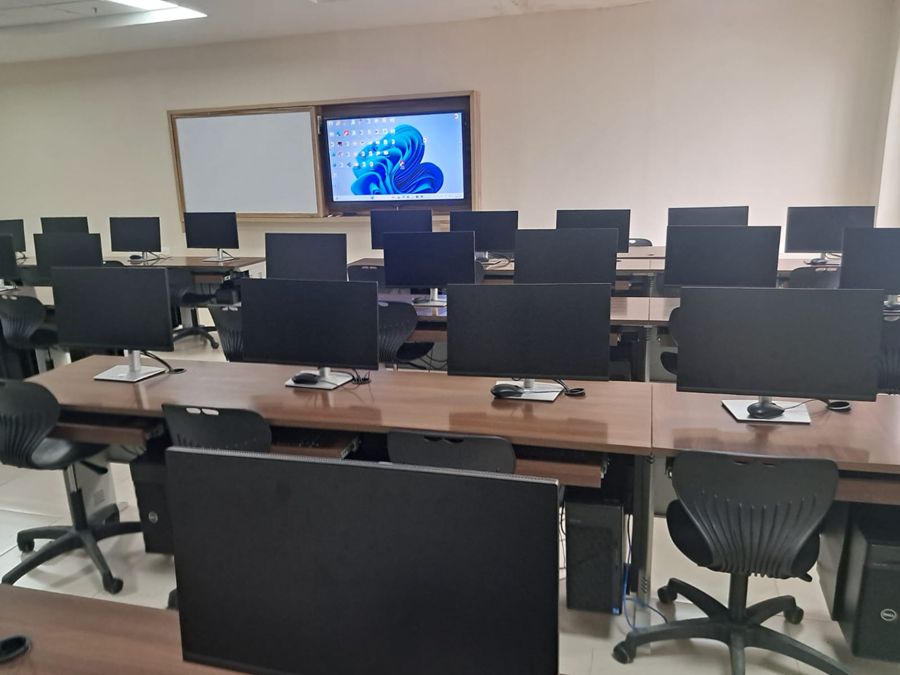
The Data Structure Lab was enhanced with modern computing infrastructure, enabling students to gain hands-on experience in algorithm design, data organization techniques, and performance optimization. High-performance systems equipped with updated compilers, debugging tools, visualization environments, and version-control platforms support students in implementing both fundamental and advanced data structures. The upgraded facility allows learners to analyze algorithmic efficiency, simulate real-world computational scenarios, and engage in collaborative coding practices aligned with contemporary software engineering standards.
Click here for lab manual..Machine Learning Laboratory
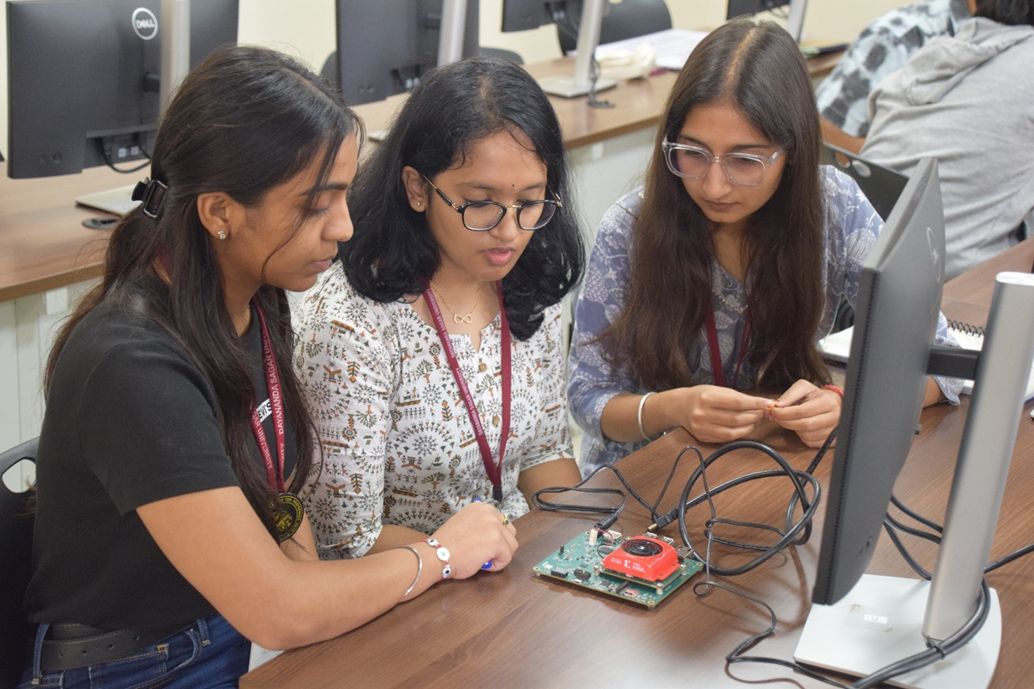
The Machine Learning Laboratory of the Department of Artificial Intelligence and Robotics is established to support teaching, research, and hands-on learning in data-driven modeling, predictive analytics, and intelligent decision-making systems. The laboratory provides students with practical exposure to the design, implementation, and evaluation of machine learning algorithms for real-world applications.
The lab enables students to work with supervised, unsupervised, and reinforcement learning techniques, including regression, classification, clustering, dimensionality reduction, ensemble methods, and deep learning foundations. Emphasis is placed on data preprocessing, feature engineering, model selection, hyperparameter tuning, performance evaluation, and interpretability, ensuring a strong end-to-end understanding of the ML lifecycle.
The Machine Learning Lab is equipped with high-performance computing systems and supports industry-standard software tools and frameworks such as Python, NumPy, Pandas, Scikit-learn, TensorFlow, PyTorch, Jupyter Lab, and visualization libraries. Students gain hands-on experience working with real-world datasets from domains such as healthcare, finance, robotics, smart cities, and autonomous systems.
The laboratory actively supports course laboratories, mini-projects, capstone projects, research activities, workshops, and faculty development programs. Students are encouraged to build predictive models, recommendation systems, anomaly detection solutions, and intelligent analytics pipelines, bridging theoretical foundations with practical implementation.
The Machine Learning Laboratory reflects the department’s commitment to delivering industry-relevant AI education, fostering analytical thinking, and preparing students with the skills required for careers in data science, artificial intelligence, robotics, and intelligent system development.
Click here for lab manual..Deep Learning Laboratory
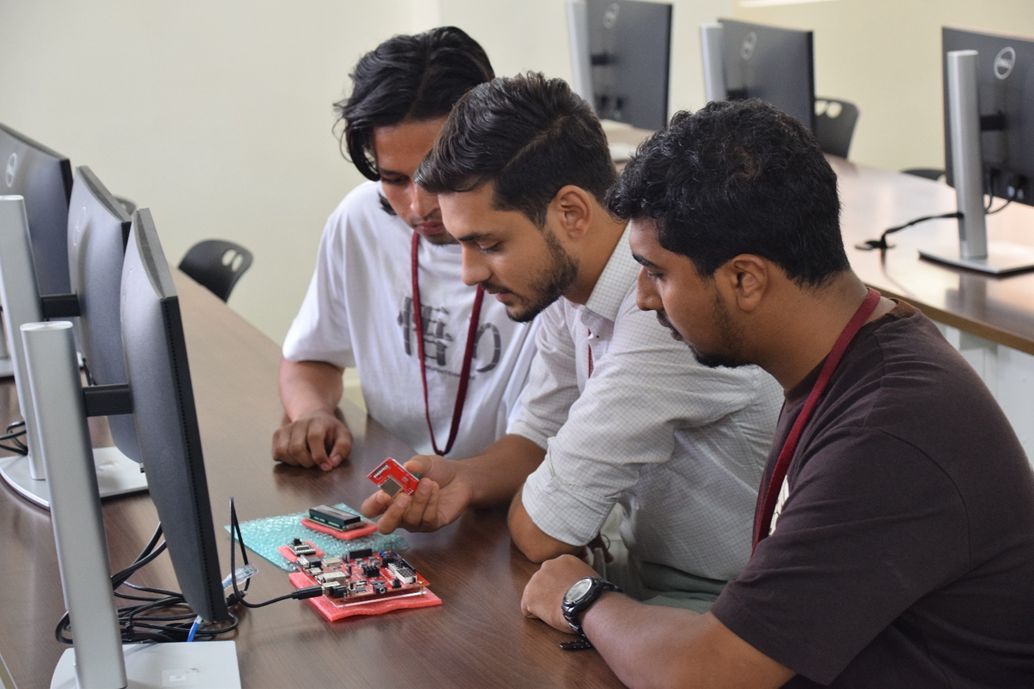
The Deep Learning Laboratory of the Department of Artificial Intelligence and Robotics is established to provide advanced training and hands-on experience in neural network architectures, representation learning, and intelligent perception systems. The laboratory supports teaching, research, and innovation in deep learning techniques that power modern AI applications across vision, language, speech, and autonomous systems.
The lab enables students to design, train, and evaluate deep neural networks, including Artificial Neural Networks (ANNs), Convolutional Neural Networks (CNNs), Recurrent Neural Networks (RNNs), LSTM/GRU models, and Transformer-based architectures. Emphasis is placed on understanding model architecture design, optimization techniques, loss functions, regularization, transfer learning, and performance evaluation.
The Deep Learning Lab is equipped with GPU-enabled computing systems and supports industry-standard frameworks such as TensorFlow, PyTorch, Keras, CUDA-enabled libraries, and Jupyter Lab. Students gain practical exposure to image classification, object detection, semantic segmentation, speech recognition, natural language processing, and multimodal learning, using real-world and benchmark datasets.
The laboratory actively supports course laboratories, mini-projects, capstone projects, research initiatives, and technical workshops, encouraging students to build scalable and efficient deep learning solutions. The lab also emphasizes responsible and ethical AI practices, including bias awareness, model robustness, and explainability.
The establishment of the Deep Learning Laboratory reflects the department’s commitment to delivering advanced AI education, fostering research-driven innovation, and preparing students with the skills required for careers in AI engineering, autonomous systems, robotics, and intelligent data analysis.
Kinematics and Dynamics Laboratory
The Kinematics and Dynamics Laboratory of the Department of Artificial Intelligence and Robotics is established to provide strong foundational and applied knowledge in robot motion, mechanism design, and dynamic system analysis. The laboratory supports teaching, research, and hands-on experimentation in the mathematical and physical principles governing robotic and mechanical systems.
The lab enables students to study and analyze position, velocity, acceleration, force, and torque relationships in robotic manipulators and mobile robots. Students gain practical exposure to forward and inverse kinematics, Jacobian analysis, workspace analysis, dynamic modeling using Newton–Euler and Lagrangian methods, and stability analysis of mechanical systems. Emphasis is placed on understanding motion behavior in serial and parallel manipulators, robotic arms, and articulated mechanisms.
The laboratory is equipped with robotic manipulators, mechanical linkages, motion analysis kits, sensor-integrated setups, and computing systems for simulation and experimentation. Industry-standard software tools such as MATLAB/Simulink, Python-based modeling libraries, ROS, and multibody simulation environments are used to model, simulate, and validate kinematic and dynamic behavior before real-time implementation.
The Kinematics and Dynamics Lab supports laboratory courses, mini-projects, capstone projects, and research activities, enabling students to bridge theoretical concepts with real-world robotic applications. The lab also serves as a foundation for advanced domains such as robot control, autonomous navigation, humanoid robotics, ADAS, and industrial automation.
The establishment of this laboratory reflects the department’s commitment to building strong engineering fundamentals and preparing students with the analytical and practical skills required for robotics, automation, and intelligent system design.
Click here for lab manual..Hydraulics and Pneumatics Lab
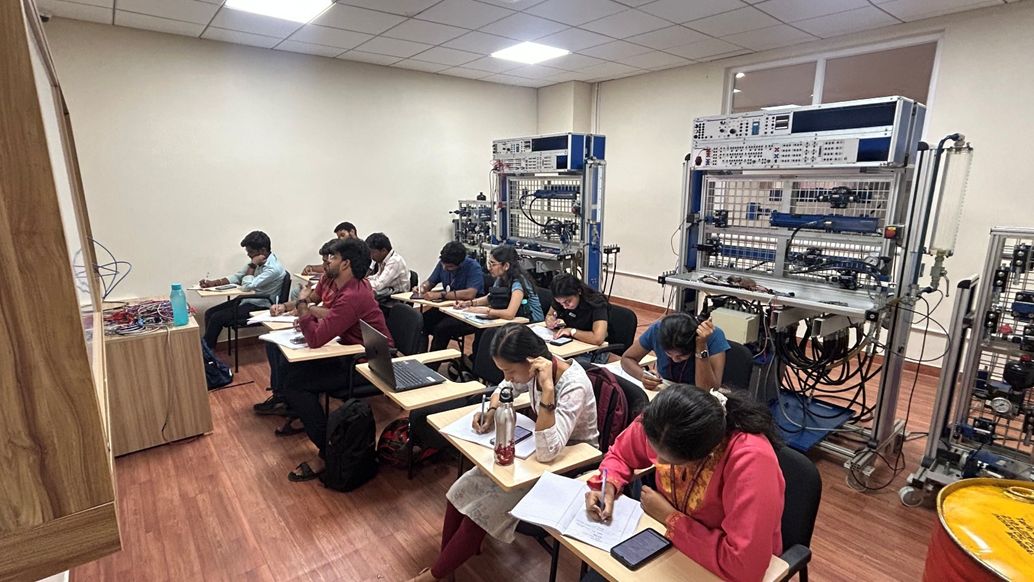
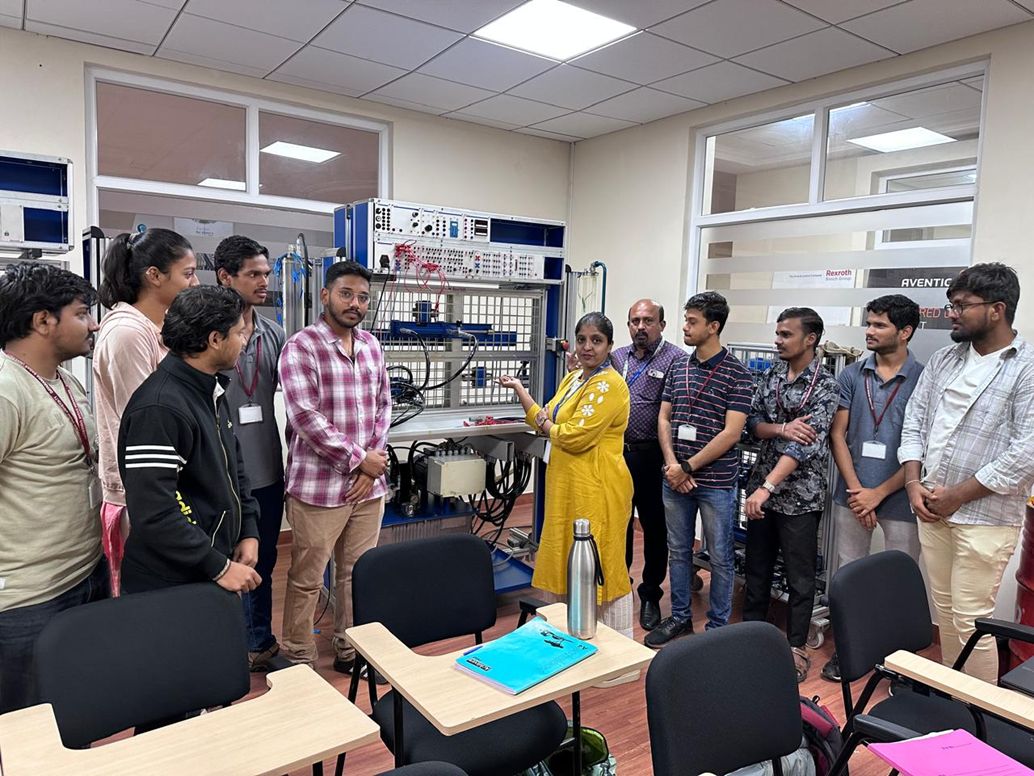
The Bosch Rexroth Centre of Excellence (CoE) at Dayananda Sagar University (DSU), aligned with the Department of Robotics & Artificial Intelligence, functions as a regional hub for strengthening industry-ready automation competencies. The CoE focuses on developing employability skills by delivering practice-oriented learning and certification-style training for DSU students and faculty, while also extending structured programs to nearby vocational institutes, polytechnics, and engineering colleges, and supporting working professionals seeking upskilling in modern industrial automation.
The center’s training and lab activities span key industrial domains including hydraulics, pneumatics, PLCs, sensorics, AC servo drives, CNC control systems, and mechatronics, enabling learners to connect automation hardware with intelligent control and robotics workflows. The CoE is designed to accommodate batches of up to 20 learners for hands-on sessions in hydraulics, pneumatics, PLC, sensorics, and Industry 4.0, ensuring guided experimentation, troubleshooting, and application-focused outcomes.
Facilities at the CoE include dedicated Hydraulics Training Kits (directional control valves, double-acting cylinders, hydraulic motors, accumulator, and sensors) and Pneumatics Training Kits (directional control valves, double-acting cylinders, and sensors) to build strong fundamentals in fluid power systems.
To support industrial control and robotics integration, the CoE provides PLC Training Kits comprising PLCs, IndraWorks/IndraLogic licensed software, a universal simulator, and basic HMI for programming, commissioning, and control logic verification. The lab also includes a Sensors Kit featuring capacitive and inductive sensors for industrial sensing and automation interfacing, along with a Drives & Control Kit to train learners on motion control essentials relevant to servo-based automation and robotic systems.
Click here for lab manual..Programmable Logic Controller (PLC) Laboratory
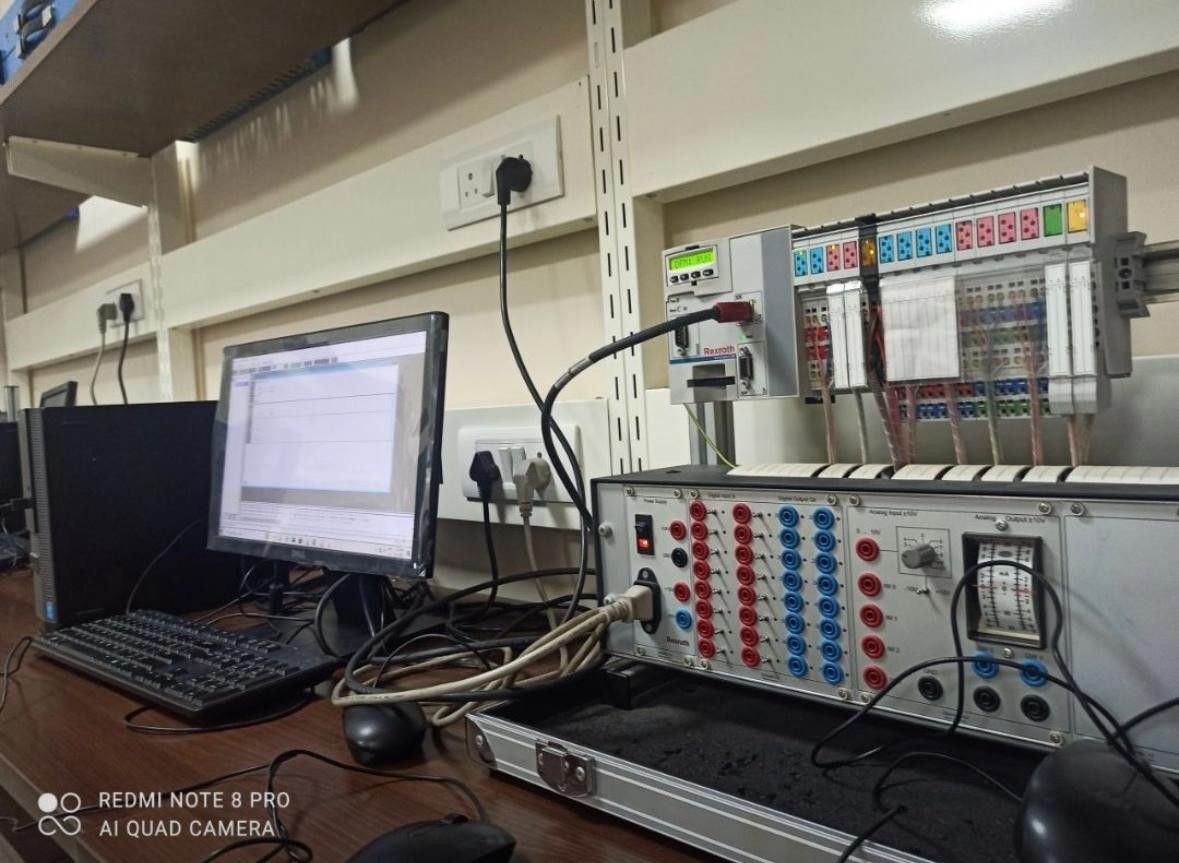
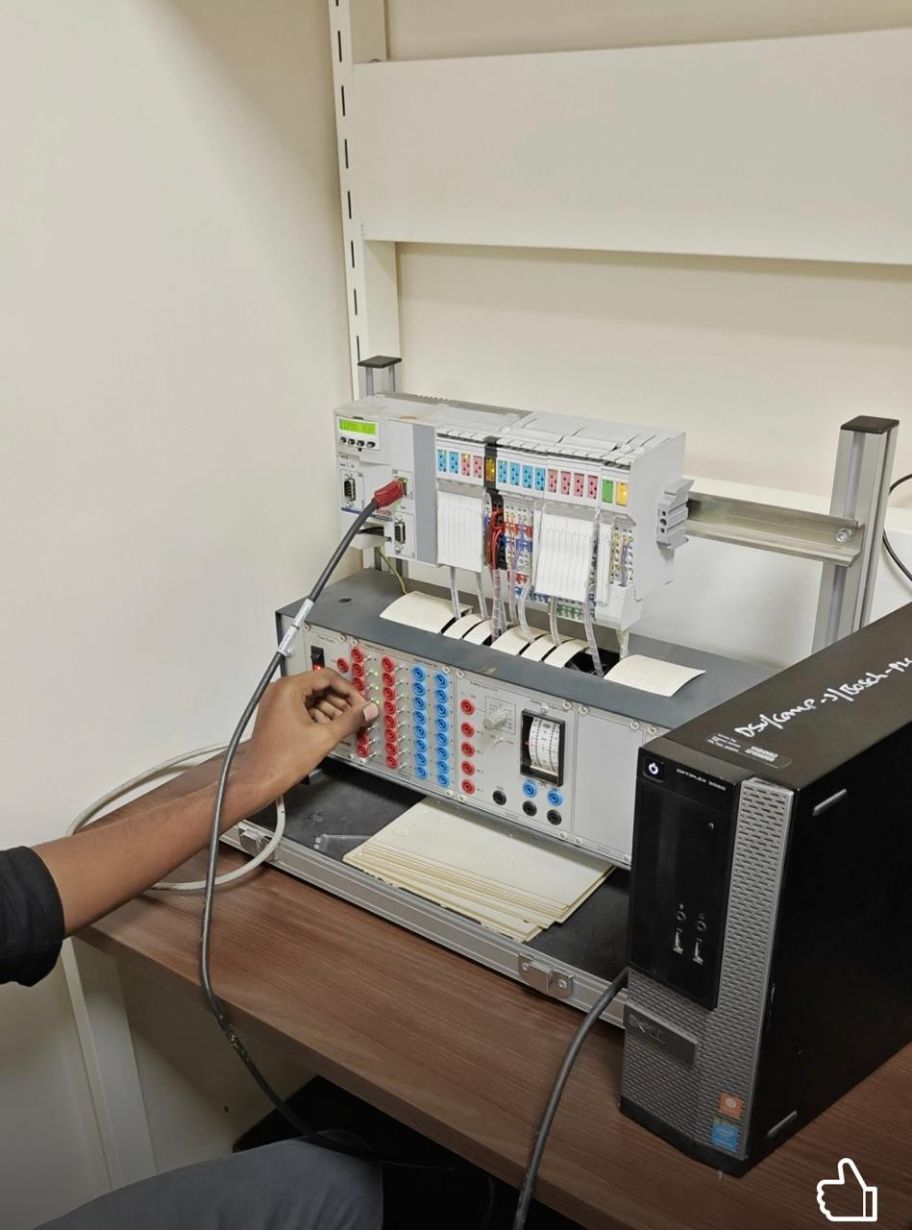
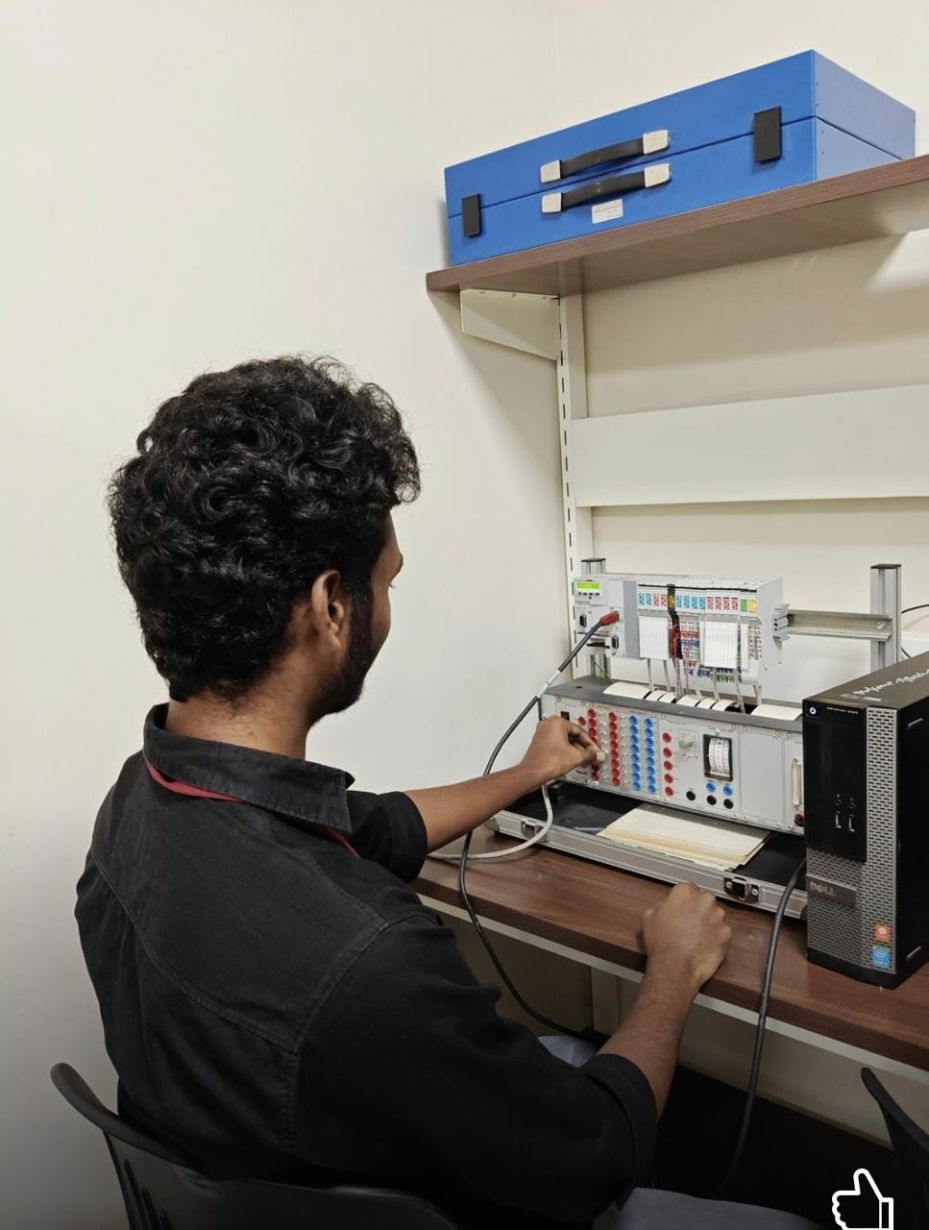
The Programmable Logic Controller (PLC) Laboratory of the Department of Artificial Intelligence and Robotics is established to provide hands-on training in industrial automation, control systems, and real-time process control. The laboratory supports teaching, skill development, and applied learning in PLC programming, industrial control logic, and automation workflows used in modern manufacturing and process industries.
The PLC Lab enables students to design, program, and test automation solutions using ladder logic, function block diagrams (FBD), structured text, and sequential function charts. Students gain practical exposure to sensor interfacing, actuator control, industrial I/O modules, motor control, timing and counting operations, and safety interlocks, closely reflecting real-world industrial scenarios.
The laboratory is equipped with industry-grade PLC trainers and automation hardware from leading manufacturers, along with Human–Machine Interface (HMI) panels, SCADA integration tools, variable frequency drives (VFDs), sensors, and actuators. Industry-standard software platforms are used for PLC configuration, simulation, debugging, and real-time monitoring of control systems.
The PLC Lab actively supports laboratory courses, skill-based training, mini-projects, and industry-oriented workshops, enabling students to implement automation solutions for conveyor systems, process plants, robotic work cells, and smart manufacturing environments. Emphasis is placed on industrial standards, reliability, safety, and system integration.
The establishment of the PLC Laboratory demonstrates the department’s commitment to industry-aligned education, equipping students with practical automation skills and preparing them for careers in industrial automation, robotics integration, smart factories, and control system engineering.
Click here for lab manual..Fundamentals of Robot Mechanics Laboratory
The Fundamentals of Robot Mechanics Laboratory of the Department of Artificial Intelligence and Robotics is established to provide students with a strong foundation in the mechanical principles underlying robotic systems. The laboratory supports teaching and hands-on learning in the structural, kinematic, and dynamic aspects of robots, which are essential for the design, analysis, and control of robotic mechanisms.
The lab enables students to explore key concepts such as robot link and joint configurations, degrees of freedom, coordinate transformations, forward and inverse kinematics, workspace analysis, and basic dynamic behavior. Students gain practical exposure to mechanism modeling, motion analysis, force and torque transmission, and payload considerations in robotic manipulators and mobile robotic platforms.
The laboratory is equipped with robotic mechanism kits, articulated robot models, mechanical linkages, transmission systems, sensors, and computing facilities to support experimentation and visualization of robot motion. Simulation and analysis are carried out using MATLAB, Python-based modeling tools, and robotics simulation environments, allowing students to validate theoretical concepts through virtual and physical experiments.
The Fundamentals of Robot Mechanics Lab serves as a core foundational laboratory for advanced studies in robot control, autonomous systems, industrial robotics, humanoid robots, ADAS, and intelligent automation. It supports laboratory courses, mini-projects, and design-oriented activities that bridge classroom learning with real-world robotic applications.
The establishment of this laboratory reflects the department’s commitment to building strong engineering fundamentals, analytical thinking, and practical skills essential for aspiring professionals in robotics, automation, and intelligent system development.
Robotic Operating Systems (ROS) Laboratory
The Robotic Operating Systems (ROS) Laboratory of the Department of Artificial Intelligence and Robotics is established to provide hands-on training in robot software architecture, middleware frameworks, and real-time robot application development. The laboratory supports teaching, research, and experiential learning in the design, simulation, and deployment of autonomous robotic systems using ROS and ROS 2.
The lab enables students to develop and integrate robotic software components using ROS/ROS 2 nodes, topics, services, actions, and packages. Students gain practical exposure to sensor integration, actuator control, robot communication, navigation, localization, and mapping (SLAM) in both simulated and real-world environments. Emphasis is placed on modular software design, distributed systems, and real-time data handling for robotic applications.
The ROS Lab is equipped with Linux-based computing systems, robotic platforms, sensor kits, and simulation environments such as Gazebo, RViz, and CARLA. Industry-standard tools and programming languages including Python and C++ are used to develop, test, debug, and visualize robotic behaviors. Students learn to interface cameras, LiDAR, IMU, and other sensors with ROS-based systems.
The laboratory actively supports course laboratories, mini-projects, capstone projects, workshops, and research initiatives, enabling students to build applications such as autonomous mobile robots, robotic arms, perception pipelines, and ADAS-oriented robotic systems. The lab also emphasizes scalable, secure, and industry-aligned robotic software practices.
The establishment of the Robotic Operating Systems Laboratory reflects the department’s commitment to providing industry-relevant robotics education and preparing students with the software skills required for careers in robotics engineering, autonomous systems, industrial automation, and intelligent mobility.
Reinforcement Learning Laboratory
The Reinforcement Learning (RL) Laboratory of the Department of Artificial Intelligence and Robotics is established to provide advanced hands-on training in sequential decision-making, adaptive learning, and autonomous control systems. The laboratory supports teaching, research, and experiential learning in learning-based control and optimization techniques used in robotics, autonomous systems, and intelligent agents.
The lab enables students to design, train, and evaluate reinforcement learning agents using foundational and advanced methods such as Markov Decision Processes (MDPs), dynamic programming, Monte Carlo methods, temporal-difference learning, Q-learning, SARSA, and policy-gradient approaches. Students gain practical exposure to deep reinforcement learning (DRL) techniques, including DQN, PPO, A3C, DDPG, and SAC, applied to complex control and navigation tasks.
The Reinforcement Learning Lab is equipped with GPU-enabled computing systems and supports industry-standard tools and frameworks such as Python, OpenAI Gym/Gymnasium, Stable Baselines, TensorFlow, PyTorch, and simulation environments like Gazebo, MuJoCo, and CARLA. These platforms allow students to experiment with robot control, path planning, manipulation, resource allocation, and autonomous decision-making in simulated and real-world-inspired environments.
The laboratory actively supports course laboratories, mini-projects, capstone projects, and research initiatives, enabling students to build intelligent agents for robot navigation, multi-agent coordination, ADAS scenarios, and autonomous vehicle control. Emphasis is placed on reward design, exploration–exploitation trade-offs, safety constraints, and policy evaluation.
The establishment of the Reinforcement Learning Laboratory reflects the department’s commitment to delivering cutting-edge AI education and preparing students with the skills required for careers in robotics, autonomous systems, AI research, and intelligent control engineering.
Click here for lab manual..Advanced Driver Assistance Systems (ADAS) Laboratory
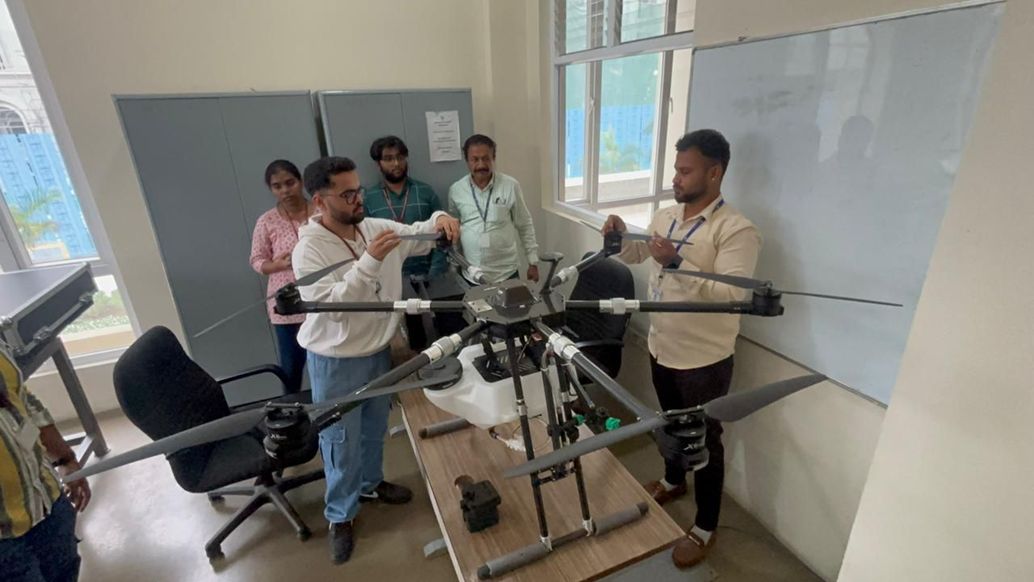
During the academic year, the Department of Artificial Intelligence and Robotics established the Advanced Driver Assistance Systems (ADAS) Laboratory to support teaching, research, and hands-on learning in intelligent transportation systems, autonomous driving technologies, and vehicular perception and control. The laboratory is designed to provide students with practical exposure to sensor-based perception, real-time decision-making, and AI-driven vehicle assistance systems.
The ADAS Lab is equipped with advanced computing platforms, simulation tools, and sensor interfaces to facilitate experimentation with camera-, LiDAR-, radar-, and ultrasonic-based perception systems. Students work on real-world ADAS use cases such as lane detection, object and pedestrian detection, traffic sign recognition, collision avoidance, adaptive cruise control, and driver monitoring systems. The lab environment enables end-to-end development—from sensor data acquisition and fusion to algorithm design and real-time deployment.
To strengthen the software ecosystem, the laboratory supports industry-standard tools and frameworks such as Python, OpenCV, ROS/ROS2, MATLAB/Simulink, deep learning frameworks, and simulation environments like CARLA and Gazebo. These tools enable students to design, test, and validate ADAS algorithms in virtual driving scenarios before transitioning to real-time embedded platforms.
The ADAS Lab actively supports student projects, capstone design, internships, workshops, and research initiatives, encouraging innovation in areas such as autonomous navigation, smart mobility, vehicle-to-everything (V2X) communication, and safety-critical AI systems. Emphasis is placed on functional safety, real-time constraints, and ethical considerations in autonomous driving technologies.
The establishment of the ADAS Laboratory reflects the department’s commitment to delivering industry-aligned, future-ready education and preparing students with the skills and competencies required for careers in automotive AI, autonomous vehicles, and intelligent mobility systems.
GenAI and LLM Lab
The Department of Artificial Intelligence and Robotics established the Generative AI and Large Language Models (LLM) Laboratory to support advanced teaching, research, and hands-on learning in generative modeling, natural language processing, multimodal AI, and AI-driven decision systems. The laboratory is designed to provide students with practical exposure to the development, fine-tuning, and deployment of state-of-the-art generative AI models for real-world applications.
The lab is equipped with high-performance GPU-enabled computing systems and scalable AI infrastructure to support training and inference of large language models. Students work with leading open-source and enterprise frameworks such as PyTorch, TensorFlow, Hugging Face Transformers, LangChain, LlamaIndex, and ONNX, enabling experimentation with prompt engineering, parameter-efficient fine-tuning (PEFT), retrieval-augmented generation (RAG), and model optimization techniques.
To bridge theory with practice, the laboratory supports end-to-end GenAI workflows, including dataset preparation, tokenization, model training, evaluation, deployment, and monitoring. Students gain hands-on experience in building chatbots, intelligent assistants, document summarization systems, code-generation tools, and multimodal applications integrating text, vision, and speech. The lab also facilitates secure and responsible AI development, emphasizing ethical AI practices, bias mitigation, data privacy, and model governance.
The GenAI and LLM Lab is actively utilized for student projects, research initiatives, workshops, and faculty development programs, fostering innovation in areas such as AI-powered education, healthcare analytics, autonomous systems, and smart decision support. This laboratory reflects the department’s commitment to delivering future-ready AI education and nurturing skilled professionals capable of designing, deploying, and governing next-generation generative AI solutions.
Click here for lab manual..Robotic Vision Lab
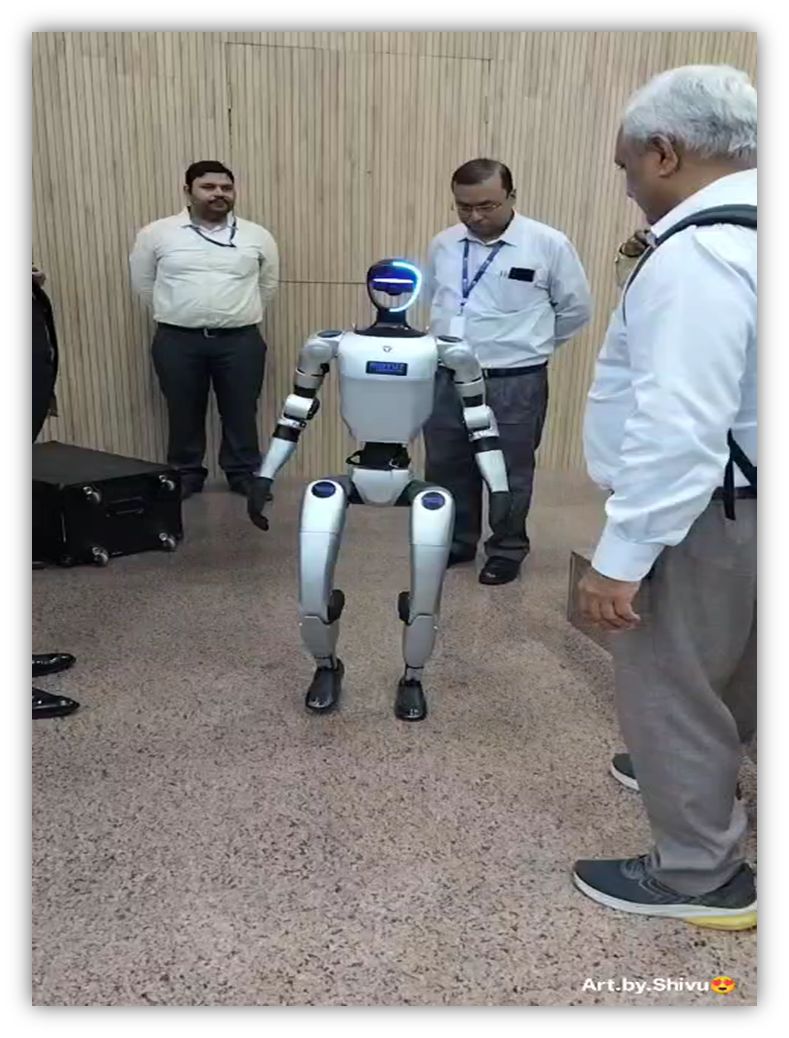
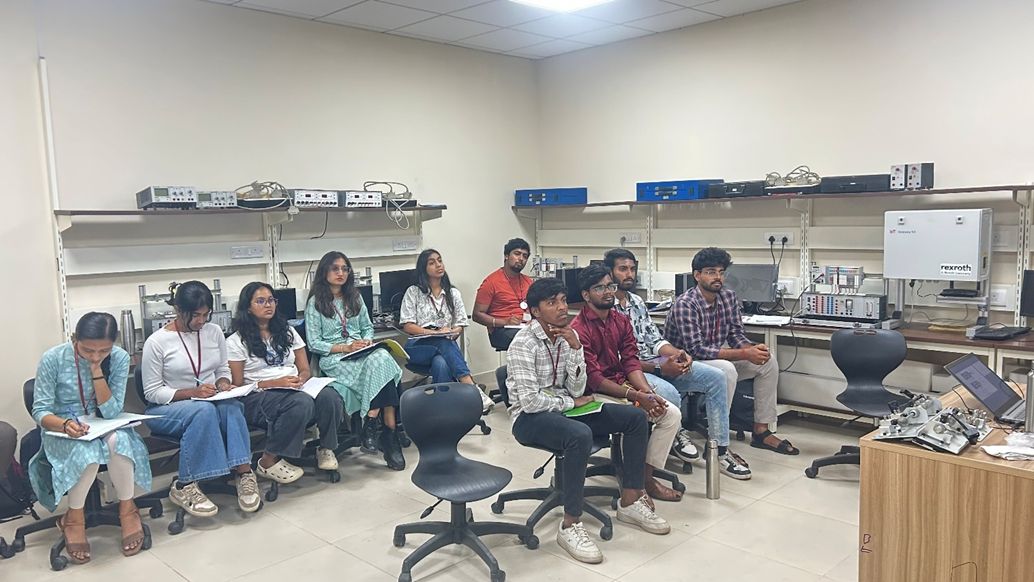
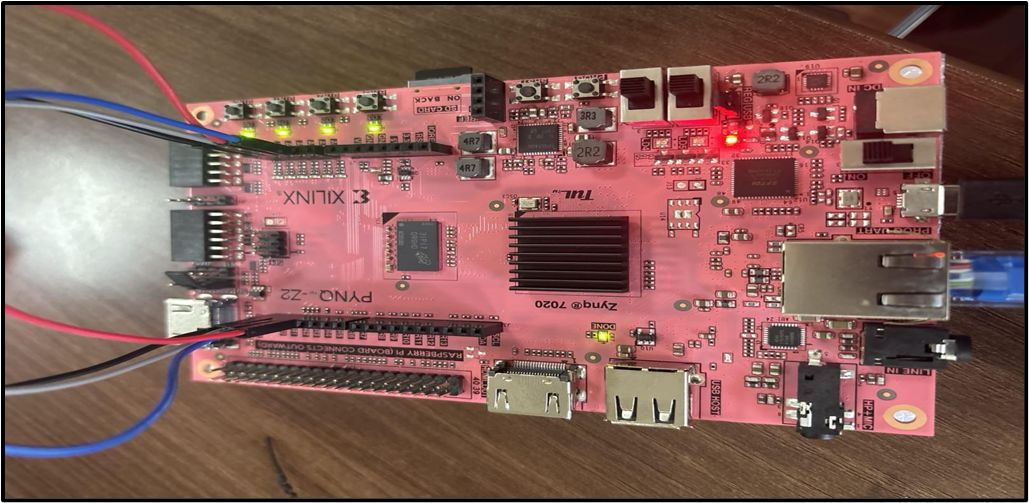
The Department of Artificial Intelligence and Robotics significantly enhanced the Robotics Vision Laboratory by establishing advanced infrastructure to support teaching, research, and hands-on experimentation in robotic vision, embedded intelligence, FPGA-based vision systems, and edge AI computing. The laboratory is equipped with state-of-the-art Zynq-based System-on-Chip (SoC) development platforms, including ZYNQ FPGA boards, Xilinx Kria KV260 Vision AI Starter Kits, PYNQ boards, and complementary NVIDIA and Xilinx hardware platforms for comparative analysis of vision-processing workflows.
These facilities enable students to acquire practical expertise in computer vision for robotics, real-time image and video processing, hardware–software co-design, and AI model deployment on edge devices.
Learners gain hands-on exposure to SoC architectures, smart camera pipelines, and real-time AI-driven perception systems essential for autonomous and robotic applications.
The laboratory’s software ecosystem is strengthened with industry-standard licensed tools such as the Xilinx Vivado Design Suite, Microwind VLSI Design Software, and Jupyter Lab for Python-based development and hardware acceleration using PYNQ overlays. These tools support the complete code-to-hardware development lifecycle, encompassing design specification, synthesis, implementation, bitstream generation, and system verification.
The Robotics Vision Lab is actively utilized for workshops, hands-on training programs, and project-based learning, enabling students to program FPGAs, develop smart vision applications, configure Linux-based edge AI devices, and design CMOS logic circuits using professional VLSI tools. These infrastructure advancements demonstrate the department’s strong commitment to providing cutting-edge learning environments and cultivating industry-ready skills in artificial intelligence, robotics, and intelligent vision systems.
Click here for lab manual..