


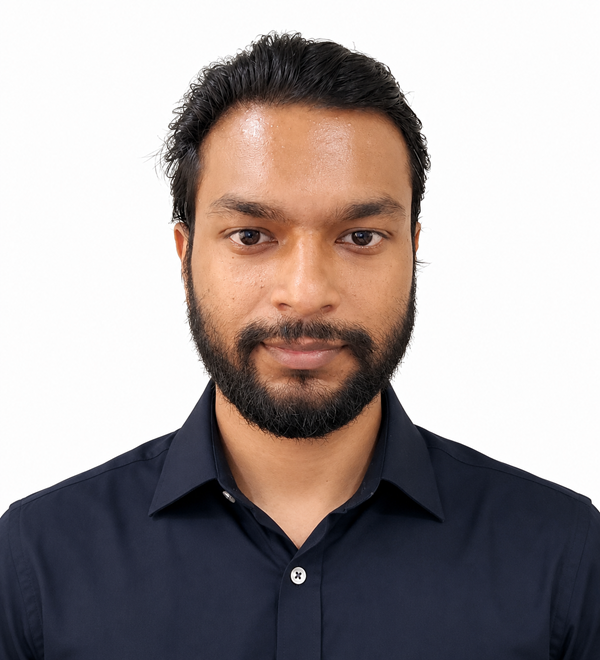
Prof. Rohit Kumar
Assistant Professor
Prof. Rohit Kumar is an Assistant Professor in the Department of Artificial Intelligence and Machine Learning (AIML) at Dayananda Sagar University, Bengaluru. He is passionate about teaching and enjoys helping students build a strong foundation in computing, problem-solving, and emerging technologies. His academic interests lie in Artificial Intelligence, Machine Learning, Data Science, and Computer Vision, where he actively explores both theoretical concepts and practical applications.
He completed his Master of Technology (M.Tech) in Computer Science and Engineering from the Indian Institute of Technology (IIT) Dharwad, Karnataka, and earned his Bachelor of Technology (B.Tech) in Biotechnology from Netaji Subhas University of Technology (NSUT), New Delhi. His academic journey across multiple disciplines has given him a unique perspective on applying computational techniques to solve complex real-world problems.
During his postgraduate studies at IIT Dharwad, Mr. Kumar worked on graph-theoretic problems and algorithm design, focusing on universal graph embeddings and related computational challenges. He has also been involved in developing data-driven solutions for applications in healthcare, predictive analytics, and intelligent decision-support systems. His work combines strong theoretical foundations with practical problem-solving approaches to address real-world challenges.
His areas of expertise include Algorithms, Data Structures, Artificial Intelligence, Data Analytics, Computer Vision, Database Management Systems, and Predictive Modelling. He is proficient in Python, C++, SQL, and has experience working with modern computational and data analysis tools including OpenCV, Scikit-learn, NumPy, Pandas, Tableau, Git, and LaTeX.
Mr. Kumar's academic interests span intelligent computing, graph theory, medical image analysis, data analytics, and emerging computational technologies. He believes in creating an engaging learning environment that encourages curiosity, critical thinking, and innovation. Through teaching and research, he aims to help students develop strong analytical skills and apply technology to solve meaningful real-world problems.

- Home

- Prof. Rohit Kumar


The future is intelligent. And it is being built at DSU. Be part of India's AI revolution.
About
Brochures
Admissions

DSU Main Campus:
- Devarakaggalahalli, Harohalli,
Kanakapura Road,
Bengaluru South Dt. – 562 112
E-mail: [email protected] DSU City Innovation Campus:
- Administrative & Main Admission office,
Kudlu Gate, Hosur Road,
Bengaluru - 560 114
Admissions Helpline: 080 46461800 / 080 49092800 / +91 7760964277 / 8296316737 / 6366885507
E-mail: [email protected] | [email protected] - Office of Registrar: 080 4909 2910 / 11
Office of Dean (Engineering): +91 80 4909 2986 / 32 / 33
Dean - MBA: 080 4909 2931
Enquiry EMBA: 080 4909 2930
Research Cell: 080 4909 2912 DSU City Admissions Office:
- Gate 2, 6th Floor, University Building,
Dental Block, Kumaraswamy Layout,
Bengaluru - 560111
Admissions Helpline: 080 46461800 / 080 49092800 - E-mail: [email protected] / [email protected]